
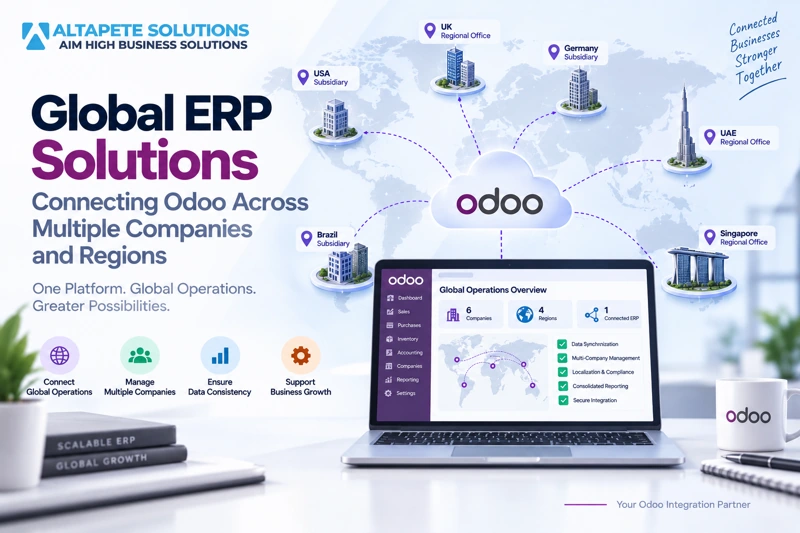
Global ERP Solutions: Connecting Odoo Across Multiple Companies and Regions
Global ERP solutions help organizations connect business operations across countries, subsidiaries, legal entities, and regional teams while maintaining consistent data, reporting, governance, and operational control. For companies using Odoo, an effective global enterprise resource planning strategy can create a connected digital environment without forcing every region to operate in exactly the same way.
As businesses expand internationally, ERP complexity increases quickly. A company may have headquarters in one country, subsidiaries in several regions, different currencies, local tax requirements, separate Odoo databases, and teams that follow different operational processes. Without a clear ERP architecture, these differences can lead to fragmented data, inconsistent reporting, and duplicated administrative work.
The purpose of global ERP solutions is not simply to place every business unit inside one software system. The goal is to create the right balance between centralized visibility and regional flexibility while ensuring that important information can move accurately between companies.
This guide explains how Odoo can support a global ERP strategy, when multi-company ERP is appropriate, when separate regional databases make more sense, and how global ERP integration can connect independent Odoo environments across an international organization.
What Are Global ERP Solutions?
Global ERP solutions are enterprise systems and integration architectures designed to manage business processes across multiple companies, countries, currencies, and operational environments. They provide a framework for connecting finance, sales, purchasing, inventory, manufacturing, customer management, reporting, and other core activities across a wider organization.
A global ERP architecture needs to do more than centralize information. It must account for local regulations, tax structures, currencies, languages, reporting requirements, business processes, and operational differences between regions. These requirements often make a single standardized configuration difficult for large multinational organizations.
Odoo provides several ways to approach this challenge. Businesses can operate multiple companies inside one Odoo database, maintain independent Odoo instances for different regions, or combine both approaches with enterprise Odoo integration.
The right architecture depends on how much independence each business unit needs and how much information must be shared across the organization.
Why Global Businesses Need a Connected ERP Strategy
International growth often creates disconnected systems gradually. One subsidiary may implement Odoo independently, another may maintain a regional ERP, while headquarters uses a central reporting system. Over time, business information becomes spread across several environments.
This fragmentation makes it harder for leadership teams to understand overall performance. Sales numbers may use different definitions, product information can vary between regions, and financial teams may spend significant time collecting information manually before producing consolidated reports.
A strong global ERP solutions strategy reduces these problems by defining how systems, data, and business processes should work together. It gives the organization a clear model for ownership, synchronization, reporting, and governance.
Instead of forcing every company into exactly the same workflow, the architecture can standardize what needs to be global while preserving flexibility where local operations genuinely require it.
Odoo as a Practical Global ERP Platform
Odoo can support organizations with multiple companies and regions through its modular ERP environment, multi-company capabilities, localization features, and integration options. The platform can be configured around different business functions while allowing organizations to decide how centralized or distributed their ERP architecture should be.
Odoo's multi-company capabilities allow several companies to operate within one database while maintaining company-specific records and permissions. Odoo also supports shared records where appropriate, making it possible to centralize selected information while keeping transactional data associated with the correct company.
Businesses evaluating this structure can review Odoo’s official multi-company documentation, which explains how multiple companies, company-specific records, shared data, and intercompany transactions can operate inside one database.
For larger international groups, these capabilities can become part of a broader global enterprise resource planning architecture rather than simply a local ERP configuration.
One Global Odoo Database or Multiple Regional Databases?
One of the first decisions in a global ERP project is whether every business should operate inside one Odoo environment or whether some subsidiaries should maintain independent databases.
A single environment can simplify central administration, reporting, user management, and shared business processes. If subsidiaries have similar workflows and can operate on the same technical roadmap, a multi-company ERP structure can be efficient and easier to govern.
However, regional differences may make independent systems more practical. A subsidiary may require different custom modules, integrations, workflows, infrastructure, or upgrade schedules that would be difficult to manage inside a single shared environment.
In those situations, separate databases can preserve regional independence while global ERP integration connects the information that headquarters and other companies need.
How Odoo Multi-Company Supports Global Operations
An Odoo multi-company environment allows several legal entities to operate inside the same database while retaining company-specific transactions and configuration. This can work particularly well for organizations with centralized finance, shared management, common products, or closely aligned business processes.
Authorized users can work across multiple companies according to their permissions. Selected records may be shared while other records remain company-specific, allowing the business to create a balance between centralized resources and entity-level control.
Odoo also supports intercompany transactions inside multi-company environments. This can simplify workflows when one company sells to, purchases from, or invoices another company within the same group.
For organizations with similar regional operations, this architecture can provide many of the benefits expected from global ERP solutions without requiring synchronization between independent databases.
When Separate Odoo Instances Make More Sense
Not every international organization should operate from one database. Separate Odoo instances may be better when subsidiaries need strong technical and operational independence.
A regional company may have unique regulatory requirements, local applications, custom modules, implementation partners, or business processes. Forcing all regions into one database can sometimes create more complexity than maintaining separate systems.
Independent instances can also be useful after mergers and acquisitions. A newly acquired organization may already have a stable Odoo environment that should remain operational while integration with the wider group is established.
In this model, enterprise Odoo integration becomes the bridge between regional systems and the wider global organization.
Connecting Regional Odoo Databases
When an organization operates multiple Odoo databases, it needs clear rules about what information should move between them. Synchronizing everything is rarely necessary and can create unnecessary complexity.
Headquarters may control global product information while regional databases manage local customers, inventory, or pricing. Regional systems may send sales, financial, or operational information back to headquarters for reporting and planning.
A successful global ERP integration should define synchronization direction, frequency, record ownership, field mappings, validation rules, conflict handling, and error recovery before development begins.
This approach allows businesses to keep independent environments while still maintaining the information flow required for coordinated global operations.
The Role of Localization in Global ERP
Localization is one of the most important requirements in an international ERP strategy. Countries often have different accounting standards, taxes, invoice formats, reporting rules, currencies, languages, and regulatory processes.
A global ERP architecture should support these differences without turning every local requirement into a global rule. Regional systems need enough flexibility to remain compliant while still following the organization's wider data and governance standards.
Odoo can support country-specific configurations and localization packages, but businesses should still evaluate whether all regions can realistically operate in one shared environment.
When local requirements become significantly different, independent Odoo databases connected through global ERP solutions can provide a more flexible structure.
Global Standardization vs Regional Flexibility
One of the biggest challenges in global ERP design is deciding what should be standardized and what should remain local. Too much standardization can create rigid processes that do not work well in certain regions, while excessive local flexibility can make global reporting and governance difficult.
The strongest strategy usually standardizes core master data, reporting definitions, security expectations, integration rules, and governance. Regional teams can then retain flexibility for legitimate local workflows and regulatory requirements.
For example, product identifiers may remain consistent globally while taxes and accounting configurations vary by country. A corporate customer classification may be standardized while local payment terms remain region-specific.
This balanced approach allows global ERP solutions to create consistency without ignoring the realities of international operations.
Master Data in a Global ERP Environment
Master data includes important records such as customers, suppliers, products, categories, units of measure, currencies, and other information used across business processes. Global organizations need clear ownership rules for this data.
Without central standards, two regions may create different codes for the same product or maintain conflicting versions of the same customer. These differences make consolidated reporting and synchronization more difficult.
Businesses should identify which records are globally controlled and which are locally maintained. Stable external identifiers should connect corresponding records across different databases when separate Odoo instances are used.
Strong master-data governance is one of the foundations of reliable global enterprise resource planning because every major transaction depends on consistent reference information.
Data Governance Across Multiple Companies
Governance defines who owns data, who can change it, how changes are approved, and how information is shared across the organization. Technology alone cannot answer these questions.
A global company should establish ownership for products, customers, pricing, financial structures, suppliers, and other important records. Without these rules, multiple systems may compete to control the same information.
Governance should also define what data regional companies are required to provide to headquarters and how quickly that information needs to become available.
By connecting technical integration rules with business ownership, global ERP solutions become easier to operate and maintain over the long term.
Data Synchronization Across Regions
Synchronization allows approved information to move between Odoo environments while each database remains operationally independent. The synchronization design should reflect the importance and urgency of each type of data.
Inventory availability and customer orders may require near-real-time updates, while management reporting information may be synchronized periodically. The fastest possible synchronization is not always necessary.
The integration also needs to handle duplicate prevention, record matching, mapping differences, validation errors, and temporary connection problems. Failed records should be visible and recoverable rather than disappearing silently.
Reliable synchronization is what turns multiple regional databases into a coordinated global ERP solutions ecosystem instead of a collection of disconnected systems.
One-Way Synchronization for Global Master Data
One-way synchronization is useful when one system clearly owns a type of information. Headquarters may control the global product catalog and distribute approved product updates to regional Odoo environments.
Regional companies can use those products without changing the centrally managed identifiers or descriptions. Local prices, stock availability, or region-specific attributes can remain under local control where required.
This approach reduces conflicts because ownership is clear. It also makes governance easier because users know where global information must be maintained.
For many global ERP integration scenarios, one-way synchronization is preferable to two-way data exchange unless the business genuinely needs updates from both directions.
Bi-Directional Synchronization Across Companies
Bi-directional synchronization becomes necessary when multiple systems need to create or update shared information. A regional office may create a customer that headquarters also needs, while headquarters may later update globally controlled customer information.
This approach provides flexibility but creates additional complexity. The integration must understand what happens if both systems change the same record or field.
Field-level ownership can reduce these conflicts. Headquarters may control legal names and corporate classifications while regional systems manage local delivery instructions or sales information.
A robust enterprise Odoo integration should make these rules explicit so systems do not continuously overwrite one another.
Supporting Subsidiaries Without Losing Central Control
Subsidiaries often need enough flexibility to respond to local customers, suppliers, employees, and regulations. At the same time, headquarters needs reliable information for planning, reporting, and governance.
Global ERP solutions should support both requirements. The central organization can define global standards while regional environments manage local operational details.
For example, headquarters might maintain global products and reporting categories, while subsidiaries control local pricing, warehouse operations, and country-specific financial configuration.
This architecture provides centralized visibility without requiring every business unit to sacrifice the flexibility it needs to operate effectively.
Consolidated Reporting Across Odoo Environments
Consolidated reporting is one of the strongest reasons to connect regional ERP systems. Executives need a reliable view of revenue, costs, inventory, orders, and other performance indicators across the organization.
When companies operate inside one Odoo database, cross-company reporting can be more direct. When they operate separate databases, selected information may need to be synchronized into a central reporting system or headquarters environment.
The reporting model should standardize definitions so metrics mean the same thing across regions. Revenue, margin, order status, and customer classifications should not be calculated differently without a clear business reason.
A well-designed global enterprise resource planning strategy therefore treats reporting architecture as part of the ERP design rather than as an afterthought.
Global Financial Visibility
Finance teams often need consolidated information even when accounting remains localized. Each subsidiary may maintain its own taxes, chart of accounts, currencies, and statutory reporting requirements.
The global architecture should preserve those local requirements while allowing management to receive standardized financial information for planning and performance analysis.
This may involve mapping local financial categories into common reporting structures before data is consolidated. Currency conversion and reporting periods also need consistent rules.
The objective of global ERP solutions is not to eliminate local accounting differences but to make them understandable within a unified management framework.
Currency Management in Global ERP
International organizations frequently operate in multiple currencies. Sales, purchasing, expenses, and financial reporting may all involve different local and corporate currencies.
A global ERP strategy should define how exchange rates are handled, which currency is used for local transactions, and which currency is used for consolidated reporting.
Currency configuration can remain regional while central reporting converts results according to agreed rules. This preserves local accuracy without preventing group-level analysis.
Clear currency governance helps multi-company ERP environments and separate Odoo databases produce comparable financial information across different markets.
Intercompany Transactions Across Regions
Global organizations frequently conduct transactions between subsidiaries. One company may manufacture goods while another company sells them in a regional market.
Inside a shared Odoo multi-company environment, certain intercompany workflows can be automated more directly. With separate databases, the integration may need to create corresponding sales, purchase, invoice, or other records in the second instance.
The process should clearly define which system initiates the transaction and how counterpart records are matched. Errors should be reconciled so one company does not record a transaction that the other company is missing.
Reliable intercompany processing is an important part of scalable global ERP integration.
Handling Different Odoo Versions Across Regions
Large organizations sometimes operate different Odoo versions because regional upgrades happen at different times. This is particularly common when subsidiaries have independent technical roadmaps.
Version differences can create mapping and compatibility challenges. A field or workflow available in one version may behave differently in another environment.
Integration architecture should isolate these differences through controlled transformations and version-specific mappings rather than assuming both databases are identical.
This allows global ERP solutions to connect regional systems while giving local businesses more flexibility in their upgrade schedules.
Integrating Custom Regional Modules
Regional Odoo environments may use custom modules for local regulations, industry workflows, logistics partners, payment services, or internal processes. Those customizations can make a universal ERP configuration difficult.
A global integration strategy should identify which custom fields or models need to participate in synchronization and which should remain local.
Not every regional customization needs to be understood by headquarters. Only information with a clear global business purpose should cross the integration boundary.
This selective approach reduces complexity and helps enterprise Odoo integration remain maintainable as local systems evolve.
Security in Global ERP Integration
International ERP environments contain sensitive financial, customer, supplier, employee, and operational data. Integration therefore needs a clear security architecture.
Dedicated integration accounts should have only the access required for their assigned tasks. Credentials should be protected, and synchronization activity should be monitored so unusual failures or unauthorized activity can be investigated.
Regional systems may also have different privacy or data-handling requirements. Businesses should consider whether specific information is allowed to leave a country or region before adding it to a global synchronization process.
Security needs to be designed alongside global ERP solutions, not added after systems have already been connected.
Performance and Latency Across Regions
Geographic distance, network conditions, transaction volume, and infrastructure can affect synchronization performance. A regional system should not become unusable simply because another environment is temporarily slow or unavailable.
Integration architecture can reduce this dependency by using controlled queues, retry mechanisms, and asynchronous processing where appropriate.
Businesses should define acceptable delay for each type of information. A five-minute delay may be unacceptable for certain inventory workflows but completely reasonable for management reporting.
This business-based approach helps global ERP integration deliver reliable performance without creating unnecessary technical complexity.
Error Handling and Recovery
Failures will eventually occur in any distributed ERP environment. Networks fail, credentials change, data becomes invalid, and destination systems may temporarily become unavailable.
A reliable integration should identify which records failed, why they failed, and whether they can be retried automatically. Validation problems may require manual correction, while temporary connection failures can often recover without user intervention.
Errors should never disappear silently because missing transactions can create major reporting and operational differences between regions.
Strong error handling allows global ERP solutions to remain trustworthy even when individual transactions encounter problems.
Reconciliation Across Regional Systems
Reconciliation compares information between connected systems to confirm that synchronization actually produced the expected business result.
A headquarters system may expect 10,000 regional transactions while the integration reports that only 9,985 were successfully processed. The difference should be identified and investigated before it affects financial or operational reporting.
Reconciliation can compare transaction counts, identifiers, quantities, document status, or financial totals depending on the workflow.
For international businesses, this control is particularly valuable because synchronization problems may otherwise remain unnoticed until month-end reporting or management review.
Governance for Global ERP Changes
Global ERP environments change continuously. New subsidiaries are added, Odoo versions are upgraded, workflows evolve, and local regulations introduce new requirements.
Organizations need a governance process for evaluating how these changes affect shared data, integration mappings, reporting, and security.
A new regional field may be completely local or may need to become part of the global reporting model. That decision should be intentional rather than automatically adding every new field to synchronization.
Good change governance keeps global ERP solutions scalable and prevents integrations from becoming overly complex over time.
Supporting Mergers and Acquisitions
Mergers and acquisitions often create a mixed ERP environment. The acquired organization may already use Odoo or another system with years of historical data and established operational workflows.
Immediate consolidation into one ERP can create unnecessary risk. Integration allows businesses to connect important information while both environments continue operating.
Over time, leadership can decide whether to consolidate, maintain separate databases, or create a hybrid architecture.
This makes global ERP integration useful not only for permanent international structures but also for transitional business situations.
Global ERP for Rapid International Expansion
Businesses entering new markets often need to move faster than a complete global ERP redesign would allow. A regional implementation may need to launch while headquarters continues operating its existing environment.
A modular architecture can support this growth by establishing common integration, master-data, and reporting standards without forcing every new region into an identical system immediately.
As the business matures, some regions may be consolidated while others remain independent due to legitimate local requirements.
Flexible global ERP solutions give organizations room to expand without losing the ability to create global visibility later.
Centralized vs Decentralized ERP Governance
Centralized governance gives headquarters stronger control over system design, master data, security, and upgrades. This can improve standardization but may slow regional decision-making.
Decentralized governance gives subsidiaries more authority over local systems, integrations, and workflows. This supports regional responsiveness but can create inconsistent data and duplicated technology.
Many international businesses benefit from a hybrid model. Headquarters defines global standards while regional teams control clearly defined local requirements.
Odoo can support this model through a combination of multi-company configuration and enterprise Odoo integration between separate environments.
When a Single Odoo Environment Is the Better Choice
A single Odoo environment can work well when subsidiaries use similar processes, share master data, have centralized management, and can coordinate upgrades and customizations.
This architecture reduces synchronization requirements because companies already operate inside the same broader system. Reporting and user administration can also be simpler.
Businesses should still design company access and local configuration carefully so regional teams see the correct information.
If operational differences are relatively small, one multi-company ERP environment may provide a cleaner architecture than maintaining several independent databases.
When Multiple Odoo Instances Are the Better Choice
Multiple instances are usually more appropriate when regions need meaningful technical independence. Different regulations, custom modules, infrastructure, workflows, or upgrade schedules can justify separate databases.
The key is to avoid allowing those independent systems to become isolated information silos. Headquarters should still receive the information required for global planning and governance.
This is where global ERP solutions built around integration become particularly valuable.
Separate databases can preserve local flexibility while providing controlled synchronization for the data that needs to become global.
Odoo Integration Solutions for Global Organizations
Businesses operating multiple Odoo environments can use Odoo Integration Solutions to connect subsidiaries, regional databases, and central ERP systems while maintaining appropriate operational separation.
The integration architecture should define master-data ownership, synchronization direction, validation, field mapping, conflict handling, error recovery, and reporting requirements before development begins.
This is especially important when regional instances contain different custom modules, localizations, versions, or workflows.
The goal is not simply to connect databases. It is to create a controlled global information flow that supports reliable operations and decision-making.
How to Plan a Global Odoo Architecture
Planning should begin with the organization's operating model rather than technology. Businesses need to understand which processes are truly global and which processes need to remain regional.
Next, identify master data, reporting requirements, regulatory differences, user access, currencies, integrations, and expected transaction volumes. These factors reveal whether a shared database or multi-instance architecture is more appropriate.
The organization should then define ownership and synchronization rules before building technical connections. Clear governance makes later development significantly easier.
A well-planned global enterprise resource planning architecture can expand as the organization adds new companies and regions without requiring complete redesign every time the business changes.
Common Global ERP Mistakes to Avoid
One common mistake is assuming that global ERP means every company must use exactly the same processes. Standardization is valuable, but forcing unnecessary uniformity can make regional operations harder.
Another mistake is allowing every subsidiary to build completely independent systems without shared data standards. This creates major problems when headquarters later needs consolidated reporting.
Businesses also underestimate the importance of governance. Integrations cannot reliably decide who owns a product, customer, or reporting value unless the organization has already established those responsibilities.
Successful global ERP solutions combine technology with clear operating rules rather than relying on software alone to create consistency.
How to Choose the Right Global ERP Integration Partner
A global integration project requires more than basic API development. The integration partner should understand Odoo architecture, multi-company operations, data mapping, localization, validation, security, and reporting requirements.
The provider should also be able to discuss master-data ownership and conflict resolution before writing synchronization code. These decisions determine whether the architecture remains maintainable after deployment.
Businesses should ask how failed transactions will be recovered, how different Odoo versions will be managed, and how new subsidiaries can be added later.
A strong partner designs global ERP integration around long-term operations rather than only the initial technical connection.
Final Thoughts
Global ERP solutions allow multinational organizations to connect companies and regions without sacrificing the flexibility required for local operations. The most effective architecture creates global visibility while respecting legitimate differences in tax, localization, workflows, currencies, and business processes.
Odoo can support this strategy through both multi-company ERP and separate regional databases. A shared environment works well when businesses are closely aligned, while independent instances can provide greater flexibility when subsidiaries require substantial operational independence.
When separate systems are necessary, enterprise Odoo integration can synchronize selected master data, transactions, and reporting information while preserving clear ownership and governance.
The strongest global enterprise resource planning strategy is therefore not simply centralized or decentralized. It is an architecture that connects the right information, gives the right teams control, and provides management with reliable global visibility as the organization grows.
Frequently Asked Questions About Global ERP Solutions
1. What are global ERP solutions?
Global ERP solutions are systems and integration architectures designed to manage business operations across several companies, countries, currencies, and regions. They create common standards for data, governance, reporting, and business processes while still allowing local requirements where necessary.
For Odoo organizations, this can involve one multi-company database, several connected Odoo instances, or a hybrid architecture that combines both approaches.
2. Can Odoo be used as a global ERP?
Yes. Odoo can support international organizations through multi-company functionality, localizations, multiple currencies, modular applications, and integration between separate Odoo environments.
The correct architecture depends on the number of regions involved, operational differences, reporting needs, customizations, and the level of independence each subsidiary requires.
3. What is global ERP integration?
Global ERP integration connects ERP systems or regional databases so approved information can move between them automatically. It can synchronize products, customers, transactions, inventory, reporting data, and other business information.
The integration should include clear rules for ownership, validation, mapping, synchronization direction, security, and error recovery.
4. What is multi-company ERP?
A multi-company ERP allows several legal entities or business units to operate within a shared ERP environment while maintaining company-specific transactions and configuration.
This approach is useful when companies have similar processes and benefit from shared administration, master data, reporting, and intercompany workflows.
5. Should global companies use one Odoo database or multiple databases?
The answer depends on operational requirements. One database is often suitable when companies share processes and centralized governance, while multiple databases can be better when regions require strong technical or operational independence.
When separate databases are used, integration can provide the required global data exchange without removing regional flexibility.
6. How can Odoo connect multiple subsidiaries?
Subsidiaries can operate within one multi-company Odoo database or use separate Odoo instances connected through enterprise Odoo integration.
The integration can distribute globally managed master data and return regional transactions or reporting information according to predefined governance rules.
7. How does localization affect a global ERP implementation?
Localization allows regional ERP environments to support country-specific accounting, tax, reporting, currency, and regulatory requirements.
A global architecture should standardize information that needs to be global while allowing legitimate local configuration where regional requirements differ.
8. How is consolidated reporting handled across multiple Odoo databases?
Consolidated reporting can be created by synchronizing selected information from regional databases into a central Odoo environment, reporting platform, or data warehouse.
The organization should standardize reporting definitions, account mappings, identifiers, and currency rules so data remains comparable across regions.
9. What data should be synchronized between regional Odoo systems?
Only information with a clear business purpose should be synchronized. This may include global products, customers, intercompany transactions, sales information, inventory summaries, or financial reporting data.
The business should define the owner of each data type before deciding synchronization direction and frequency.
10. When should a company use Odoo integration solutions?
Companies should consider Odoo Integration Solutions when they need to maintain separate Odoo databases while sharing important information across subsidiaries, regions, or headquarters.
This is especially useful for multinational groups, acquisitions, decentralized organizations, and businesses that require both regional autonomy and reliable global reporting.